Cosmic Reachability Windows for Interstellar Life Transfer: A Falsifiable Framework from Stellar Encounters to Lineage Establishment
Yong Zhang
Independent Researcher, Hefei 230000, Anhui, China
Corresponding author: Yong Zhang; mailing address: [insert full postal address], Hefei 230000, Anhui, China; telephone: [insert telephone number]; e-mail: 20747297@qq.com
Running title: Cosmic reachability and life transfer
Abstract
The first appearance of life on a planet does not logically imply that life first originated there. This paper proposes the Cosmic Reachability Migration Model (CRMM), a time-dependent filtering framework for evaluating whether life could be transferred between astronomical systems during transient periods of improved accessibility. The framework distinguishes four nested windows: a kinematic window W_kin defined by relative motion and flight time; a physical window W_phys that additionally requires controlled rendezvous, acceptable mission duration and basic energy feasibility; an architecture window W_arch that must be closed by a specified propulsion, braking and payload system; and an effective biological window W_eff that further requires target-environment suitability, successful entry and release, and non-zero probability of lineage establishment. As a first empirical calibration of the dynamical layer, the observed future encounter between GJ 710 and the Solar System is parameterized using b=0.0621 pc and v_p=13.899 km s−1. With an illustrative 1000 yr maximum transfer time, 17 km s−1 yields no kinematic launch window, whereas 100, 300 and 1000 km s−1 yield finite windows of approximately 11.4, 42.3 and 143.6 kyr. Adding full velocity matching produces a strong lifetime–delta-v trade-off: minimum ideal total delta-v rises from about 122 km s−1 for a 1000 yr transfer to about 2530 km s−1 for 48 yr and 15180 km s−1 for 8 yr. Architecture and biological filters can therefore close a geometrically favorable window entirely. The model does not claim that GJ 710 hosts life or habitable planets, nor that Earth received life externally. Its contribution is a falsifiable hierarchy in which any proposed migration history can fail at a dynamical, engineering, environmental or ecological layer.
1. Introduction
Research on the origin of life primarily asks how non-living chemistry can generate systems capable of self-maintenance, replication and Darwinian evolution (Sutherland 2017; Adamski et al. 2020). A different question is where the earliest life observed on a particular world first arose. These questions coincide only if one assumes in advance that the first life on a planet must have originated locally. The present paper therefore distinguishes abiogenesis from arrival: abiogenesis concerns the first transition from non-life to life, whereas arrival concerns whether already-existing life or viable biological material reached a target world from elsewhere.
Panspermia research has long examined physical transfer between astronomical bodies. Work on Mars–Earth exchange, radiation survival, ejecta transfer and capture shows that the transfer problem can be decomposed into testable stages rather than treated as a single speculative proposition (Mileikowsky et al. 2000; Horneck et al. 2010; Kawaguchi et al. 2020; Adams and Napier 2022). Star-forming clusters and other dense environments have also been studied as settings in which low relative velocities and short separations increase material exchange (Adams and Spergel 2005; Belbruno et al. 2012). Directed panspermia adds deliberate agency without establishing that such an event actually occurred (Crick and Orgel 1973).
A parallel literature on interstellar settlement has emphasized that stellar motion changes travel opportunities. Waiting for close stellar passages can sharply reduce required travel distance (Hansen and Zuckerman 2021), and Galactic settlement models explicitly include stellar motion and time-dependent connectivity (Carroll-Nellenback et al. 2019; Haqq-Misra and Fauchez 2022). Romanovskaya (2022) likewise discussed migration using stellar flybys and free-floating planets. The novelty claimed here is therefore not that stars move, that close encounters reduce travel distances, or that life can in principle be transported. The unresolved methodological gap is how to connect those observations to a complete and falsifiable sequence from transient astronomical accessibility to actual biological establishment.
CRMM addresses that gap by treating reachability as a nested set of time-dependent filters. A candidate historical encounter is not classified simply as “near” or “far”. It must successively satisfy kinematic, mission-physical, architecture-specific, target-environment and ecological-establishment conditions. Each additional layer can only preserve or shrink the preceding window; no later definition is allowed to expand a failed earlier one. This monotonic filtering rule is central to the model's falsifiability.
The paper has four aims. First, it formalizes the hierarchy of reachability windows and separates opportunity from successful life transfer. Second, it calibrates the dynamical layer with an observed stellar encounter, GJ 710. Third, it shows how rendezvous, lifetime, propulsion and braking constraints can eliminate an otherwise favorable encounter. Fourth, it defines the target-side conditions needed to distinguish viable arrival from persistent lineage establishment. The Earth is discussed only as a constrained future application, not as evidence for the model.
2. Relation to existing astrobiology and migration models
Three bodies of work are especially relevant. The first is natural and directed panspermia. Natural-transfer studies quantify ejection, shielding, flight survival, capture and impact survival, and demonstrate that each stage can impose an independent bottleneck (Mileikowsky et al. 2000; Valtonen et al. 2009; Veras et al. 2018; Adams and Napier 2022). Directed panspermia instead adds an intentional transfer mechanism (Crick and Orgel 1973). CRMM does not replace either literature; it adds an explicitly time-dependent accessibility layer and a requirement that a complete transfer path be closed at the same historical epoch.
The second body of work concerns Galactic and stellar dynamics. The concept of Galactic habitability has evolved from largely spatial maps toward models that include radial migration and dynamical mixing (Gonzalez et al. 2001; Lineweaver et al. 2004; Mitrašinović et al. 2023; Spitoni et al. 2025). Gaia-based encounter catalogues show that close stellar passages can be reconstructed probabilistically over appropriate time horizons (Bailer-Jones et al. 2018; Bailer-Jones 2022). CRMM uses this dynamical information not as evidence for life transfer, but as an input to a time-varying feasibility problem.
The third body of work concerns technological migration and settlement. Hansen and Zuckerman (2021) showed directly that patient civilizations could exploit rare close passages to reduce interstellar travel distances. Carroll-Nellenback et al. (2019) and Haqq-Misra and Fauchez (2022) modeled settlement in moving stellar fields, while Romanovskaya (2022) considered migration strategies that exploit flybys and free-floating planets. CRMM differs primarily in the direction of inference. Rather than asking how a civilization spreads given a travel rule, CRMM asks whether a particular source–target pair at a particular time survives a sequence of independently rejectable constraints all the way to persistent biology.
This distinction matters for evidential discipline. A close encounter is not itself evidence of migration. A vehicle capable of reaching a stellar system is not itself evidence of successful delivery. A viable organism arriving in a potentially habitable environment is not itself evidence of a persistent biosphere. CRMM is designed to keep these claims separate.
3. Model and methods
3.1 Objects, scope and the bottleneck formulation
Let A denote a source astronomical system and B a target system. Let P_A denote a source world that already contains life and, for the technological branch of the model, possesses an agent capable of launching biological material. Let P_B denote a target world or environment that could in principle support the selected biological payload. Time t is measured in a frame appropriate to the encounter under study.
A single scalar “cost” is useful for visualization but is not physically fundamental because distance, time, energy, radiation dose, delta-v and biological survival have different units. CRMM therefore treats feasibility first as a vector of constraints. Let q_i(t) be the demand in constraint dimension i and k_i(t) the corresponding capability limit. Define the bottleneck ratio
ρ(t) = maxᵢ [ qᵢ(t) / kᵢ(t) ] . (1)
The mission is feasible at time t only if ρ(t) ≤ 1. A normalized scalar representation can still be used for plotting, with transfer cost C*(t), capability K*(t), and R(t)=K*(t)/C*(t), but any empirical application should retain the underlying vector constraints rather than hide them in an arbitrary weighted sum.
3.2 A hierarchy of nested reachability windows
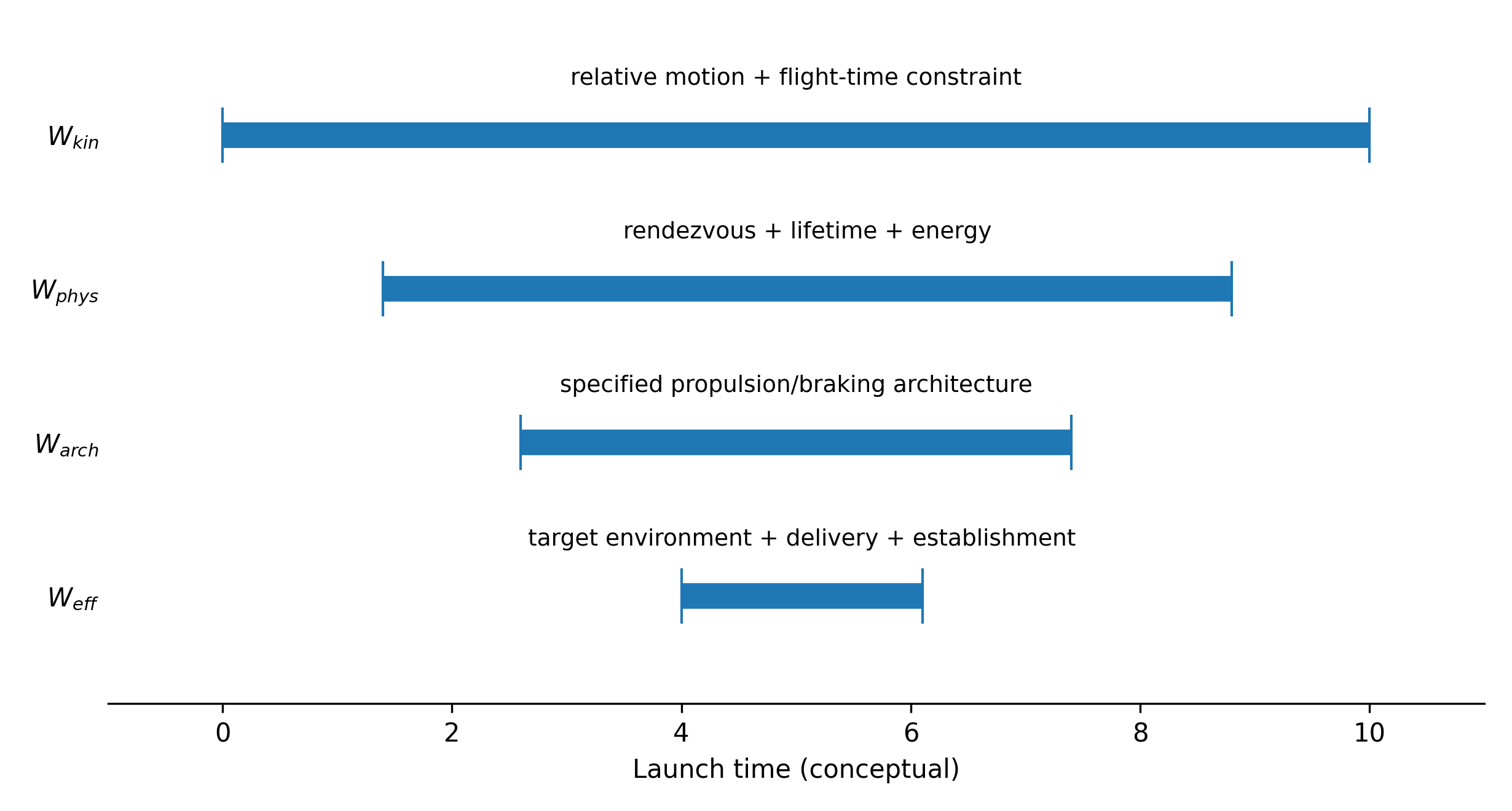
The model defines four nested windows. W_kin is the set of launch times for which relative motion, cruise speed and maximum transfer time permit interception of the moving target. W_phys is the subset for which controlled rendezvous, lifetime and first-order energy requirements are also satisfied. W_arch is the subset closed by a specified propulsion, braking, navigation, shielding and payload architecture. W_eff is the final subset for which a real target environment is suitable at arrival, the payload can enter and be released, and at least one lineage has non-zero probability of persistent establishment.
W_eff ⊆ W_arch ⊆ W_phys ⊆ W_kin . (2)
| Window | Question answered | Minimum required information | Failure condition |
|---|---|---|---|
| W_kin | Can the moving target be intercepted within the allowed flight time? | Encounter geometry, relative velocity, cruise-speed scenario, maximum flight time | No launch time satisfies interception and time constraints |
| W_phys | Can the payload rendezvous and survive the transfer at first-order physical limits? | Rendezvous delta-v, transfer lifetime, energy scale, shielding/survival limits | Any hard physical constraint is exceeded |
| W_arch | Can a specified mission architecture close the full transport loop? | Propulsion, braking/capture, payload mass, power, reliability, navigation | Architecture lacks a required subsystem or exceeds capability |
| W_eff | Can viable material reach a suitable niche and establish a persistent lineage? | Target environment at arrival, entry/release pathway, establishment model/data | Target unsuitable, delivery fails, or establishment probability is zero |
Table 1. The four nested reachability windows used in the submission version.
3.3 Repeated opportunities and cumulative migration probability
A non-empty W_eff creates opportunities but does not imply that a migration event occurs. Let λ_a(t) be the rate at which actions capable of carrying life are initiated, and let p_s(t) be the probability that a single action ultimately produces a persistent lineage. Define the effective event rate λ_eff(t)=λ_a(t)p_s(t). If events can be approximated as independent or weakly dependent for a first sensitivity calculation, the probability of at least one successful event over W_eff can be written
Pₘ = 1 − exp[ − ∫W_eff λ_eff(t) dt ] . (3)
Equation (3) is a bookkeeping relation, not an empirical law of civilization behavior. CRMM does not assume a known universal action rate. Its purpose is to prevent the common inference that a long or favorable window is automatically high-probability. If the integrated effective rate is small, the event remains unlikely; only when the integrated hazard is much greater than unity does Pₘ approach one.
4. Empirical dynamical parameterization: the GJ 710 encounter
4.1 Why GJ 710 is used
GJ 710 is used as a dynamical stress test because its future solar encounter is unusually close and comparatively well constrained. It is not proposed as a source of life or as a known host of a habitable planet. Fernandez-Puig et al. (2026) give a closest approach approximately 1.3446±0.0022 Myr in the future, with b=0.0621±0.0023 pc and relative speed v_p=13.899±0.022 km s−1. An independent Gaia DR3 analysis by Bailer-Jones (2022) gives a median closest distance of 0.0636 pc, a close-approach speed of about 14.4 km s−1, and an epoch near 1.292 Myr. These solutions are sufficiently consistent for the order-of-magnitude task filters developed here.
Near closest approach, the target motion is approximated locally as rectilinear with impact parameter b and constant transverse speed v_p. This is not a replacement for Galactic orbit integration. It is a local mission-geometry approximation applied after the encounter parameters have already been determined from astrometric and dynamical studies.
D(τ) = [ b² + (v_p τ)² ]¹ᐟ² , (4)
where τ=0 is closest approach. For a probe launched at time τ with constant cruise speed u and interception time T, the interception condition is uT=D(τ+T). Solving for T gives
T(τ;u) = {v_p²τ + [(u²−v_p²)b² + u²v_p²τ²]¹ᐟ²} /(u²−v_p²). (5)
For a maximum allowed flight time T_max, the launch-window boundaries are
τ₋,₊ = −T_max ± [(uT_max)² − b²]¹ᐟ² / v_p , (6)
provided uT_max≥b. Equation (6) highlights an important feature: the launch window is not centered on closest approach but on −T_max. A mission can exploit continuing stellar approach during the flight, so “minimum stellar separation” and “best launch epoch” are not identical concepts.
| Cruise-speed scenario | T_max | Closest-point flight time | Launch window relative to closest approach | Window width |
|---|---|---|---|---|
| 17 km s−1 | 1000 yr | ~6203 yr | None | 0 |
| 100 km s−1 | 1000 yr | ~613 yr | −6.72 to +4.72 kyr | ~11.43 kyr |
| 300 km s−1 | 1000 yr | ~203 yr | −22.14 to +20.14 kyr | ~42.28 kyr |
| 1000 km s−1 | 1000 yr | ~60.7 yr | −72.81 to +70.81 kyr | ~143.63 kyr |
Table 2. Kinematic launch windows for the GJ 710 encounter under an illustrative 1000 yr maximum transfer time. The speed values are sensitivity scenarios, not forecasts of technological capability.
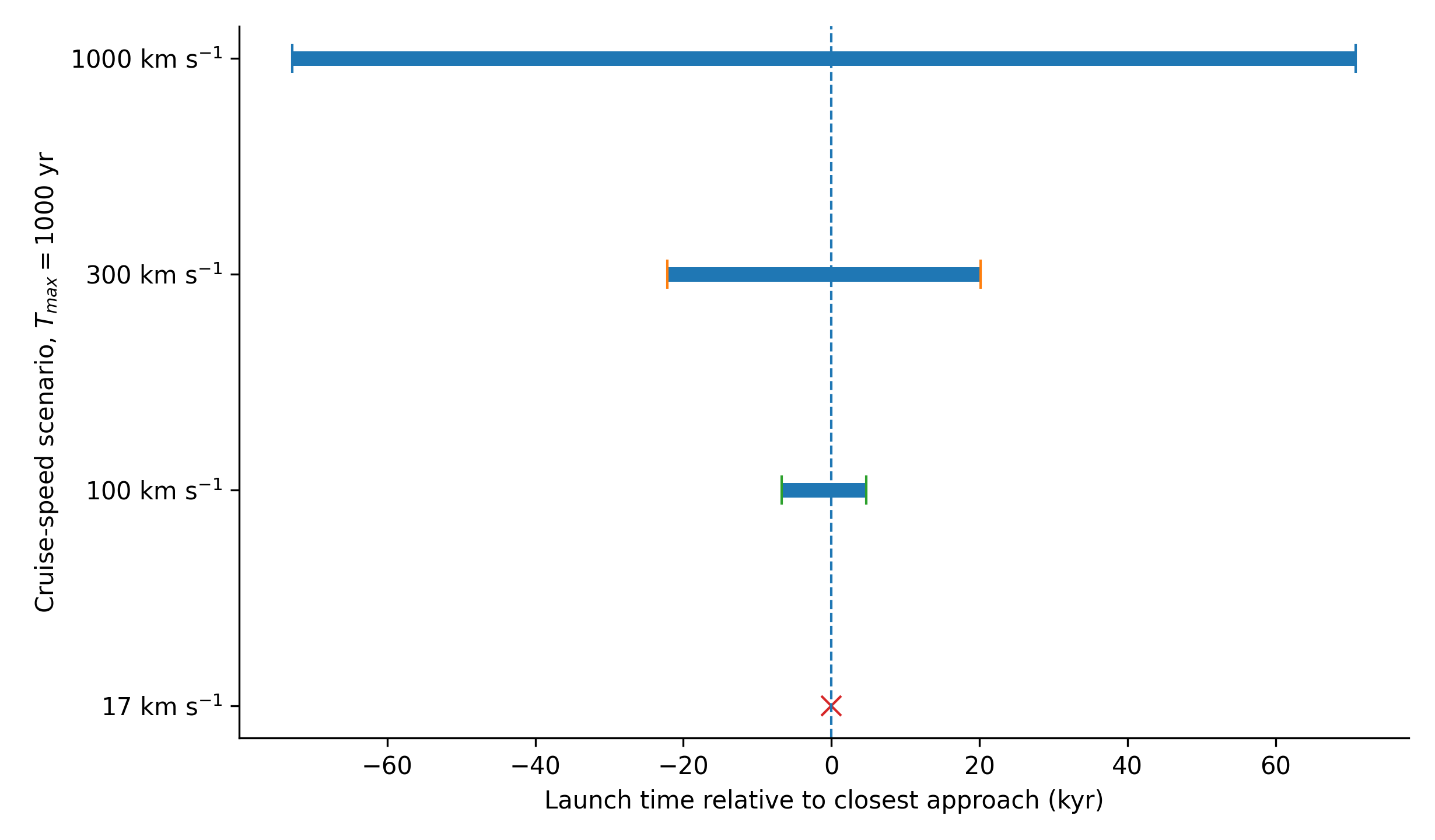
These results establish only W_kin. They show that measured relative motion can be converted into a reproducible finite launch interval and can also return an empty set. They do not show that a life-bearing payload can be accelerated, protected, slowed, delivered or established.
5. Mission-physics and architecture filters
5.1 Controlled rendezvous and lifetime constraints
A high-speed flyby is not equivalent to a controlled biological delivery. To avoid assuming unknown planets or atmospheric braking in GJ 710, a deliberately strict but transparent benchmark is used: the vehicle leaves the source-system barycentric frame and matches the target-system barycentric velocity at arrival. In the same rectilinear encounter geometry, for a launch at τ and transfer duration T, the ideal departure and arrival velocity changes are
v_dep = [(b/T)² + v_p²(1+τ/T)²]¹ᐟ² ; v_arr = [(b/T)² + v_p²(τ/T)²]¹ᐟ² , (7)
Δv_rdv = v_dep + v_arr . (8)
For fixed T, the minimum occurs at τ=−T/2, yielding
Δv_min(T) = 2[(b/T)² + (v_p/2)²]¹ᐟ² . (9)
This relation turns mission or biological lifetime directly into a propulsion requirement. The relevant transfer-time limit is T_lim=min(T_sys,T_bio), where T_sys is the longest reliable operating lifetime of the mission architecture and T_bio is the longest recoverable lifetime of the selected biological payload under its actual shielding and storage environment.
Tanpopo experiments provide useful stress-test scales rather than interstellar survival laws. Deinococcus aggregates remained viable after multi-year exposure, with extrapolations of roughly 2–8 yr under illuminated conditions and about 48 yr for dark samples in the experiment's context (Kawaguchi et al. 2020). These values cannot be transferred directly to interstellar conditions. They are used here only to demonstrate how a shorter biological lifetime translates into a much larger rendezvous requirement. Conversely, rock-shielding studies indicate that much longer transfer times can be considered for heavily shielded material, although such shielding introduces substantial mass and other penalties (Mileikowsky et al. 2000; Horneck et al. 2010).
| Allowed transfer time T | Minimum ideal total Δv | Each ideal velocity match at optimum | Interpretation |
|---|---|---|---|
| 8 yr | ~15,180 km s−1 | ~7,590 km s−1 | Short-lived/weakly protected payload becomes an extreme propulsion problem |
| 48 yr | ~2,530 km s−1 | ~1,265 km s−1 | Longer survival sharply reduces the rendezvous threshold |
| 1000 yr | ~122.2 km s−1 | ~61.1 km s−1 | Long-lived payload/system makes close passage far more useful |
Table 3. Minimum ideal barycentric rendezvous delta-v for the GJ 710 closest-approach distance. Values exclude planetary gravity wells, engine inefficiency, structural mass, navigation margins and target-world entry.
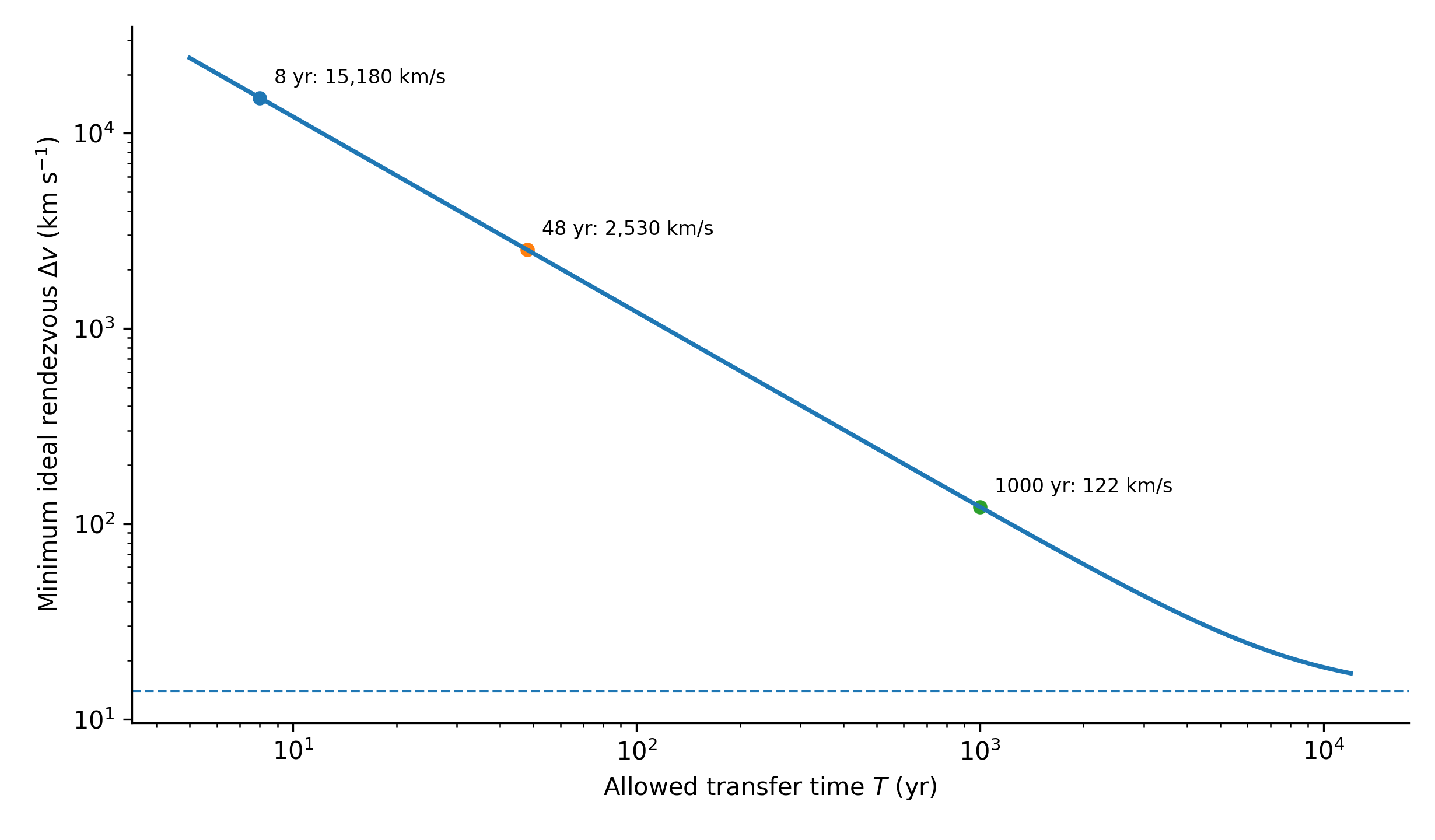
Equation (9) exposes a central CRMM result: target proximity is useful only relative to the lifetime and complete velocity-matching capability of the payload. A short-lived biological payload can turn an astronomically close encounter into an engineering non-opportunity.
5.2 Architecture closure: a slow rendezvous design can outperform a fast flyby
The next filter requires a specified architecture. Define
W_arch = W_kin ∩ W_T ∩ W_Δv ∩ W_E ∩ W_stop ∩ W_payload . (10)
The stopping/capture term W_stop is essential. If the baseline architecture cannot decelerate, capture, or otherwise deliver viable material at acceptable relative velocity, then W_stop is empty for controlled delivery and therefore W_arch is empty regardless of cruise speed.
Project Longshot provides an historical, unflown, high-capability rendezvous architecture rather than a technology forecast. The 1988 NASA/USRA concept specified a pulsed-fusion microexplosion drive with specific impulse of approximately 1.02×10^6 s, an approximately 100 yr mission to Alpha Centauri, and an acceleration–turnaround–deceleration mission profile (Beals et al. 1988). Using its reported specific impulse and gross/fuel mass only as an optimistic ideal rocket-equation envelope gives about 1.10×10^4 km s−1 of ideal total delta-v. This is not a reproduction of the Longshot trajectory and should not be interpreted as demonstrated performance. It is an architecture-scale boundary for sensitivity analysis.
Under that optimistic boundary, the GJ 710 rendezvous filter is non-empty for a 100 yr system lifetime and for a 48 yr payload-lifetime stress test, but becomes empty for the 8 yr stress test because Δv_min exceeds the ideal envelope. The resulting illustrative window widths are about 78.6 kyr for T_lim=100 yr and 36.9 kyr for T_lim=48 yr.
Breakthrough Starshot illustrates the opposite failure mode. Its baseline concept accelerates gram-scale sails to approximately 0.2c for rapid flyby science (Parkin 2018; Lubin 2016). At the GJ 710 closest distance, 0.2c would cross the separation in roughly one year, so the kinematic layer is favorable. However, the baseline architecture does not include target-system capture or controlled stopping. For the controlled-delivery definition used here, W_stop is therefore empty unless a target-specific braking mechanism is added. Photon-assisted braking has been studied for Alpha Centauri (Heller and Hippke 2017), demonstrating that sail deceleration is not impossible in principle, but that result is system-specific and cannot be transplanted to GJ 710 without a new target-star calculation.
The comparison is intentionally methodological: maximum speed is not migration capability. A slower architecture with a closed acceleration–deceleration chain can have a non-empty W_arch, while a much faster flyby architecture can fail the delivery definition.
| Illustrative architecture condition | Capability used | T_lim | CRMM result |
|---|---|---|---|
| Longshot-like ideal envelope, system-lifetime case | I_sp≈1.02×10^6 s; ideal Δv envelope≈10,989 km s−1; controlled deceleration included | 100 yr | W_arch non-empty; illustrative width≈78.6 kyr |
| Longshot-like envelope, dark-exposure lifetime stress test | Same ideal envelope | 48 yr | W_arch non-empty but narrower; width≈36.9 kyr |
| Longshot-like envelope, short-life stress test | Same ideal envelope | 8 yr | W_arch empty because Δv_min≈15,180 km s−1 exceeds envelope |
| Starshot baseline flyby | ~0.2c flyby; no baseline target capture | ~1 yr geometric crossing at b | W_stop empty for controlled delivery unless a new braking architecture is supplied |
Table 4. Architecture-level stress tests. These rows are deliberately bounded examples, not claims about current interstellar mission readiness.
6. Target environment and lineage establishment
6.1 Target suitability is also a time window
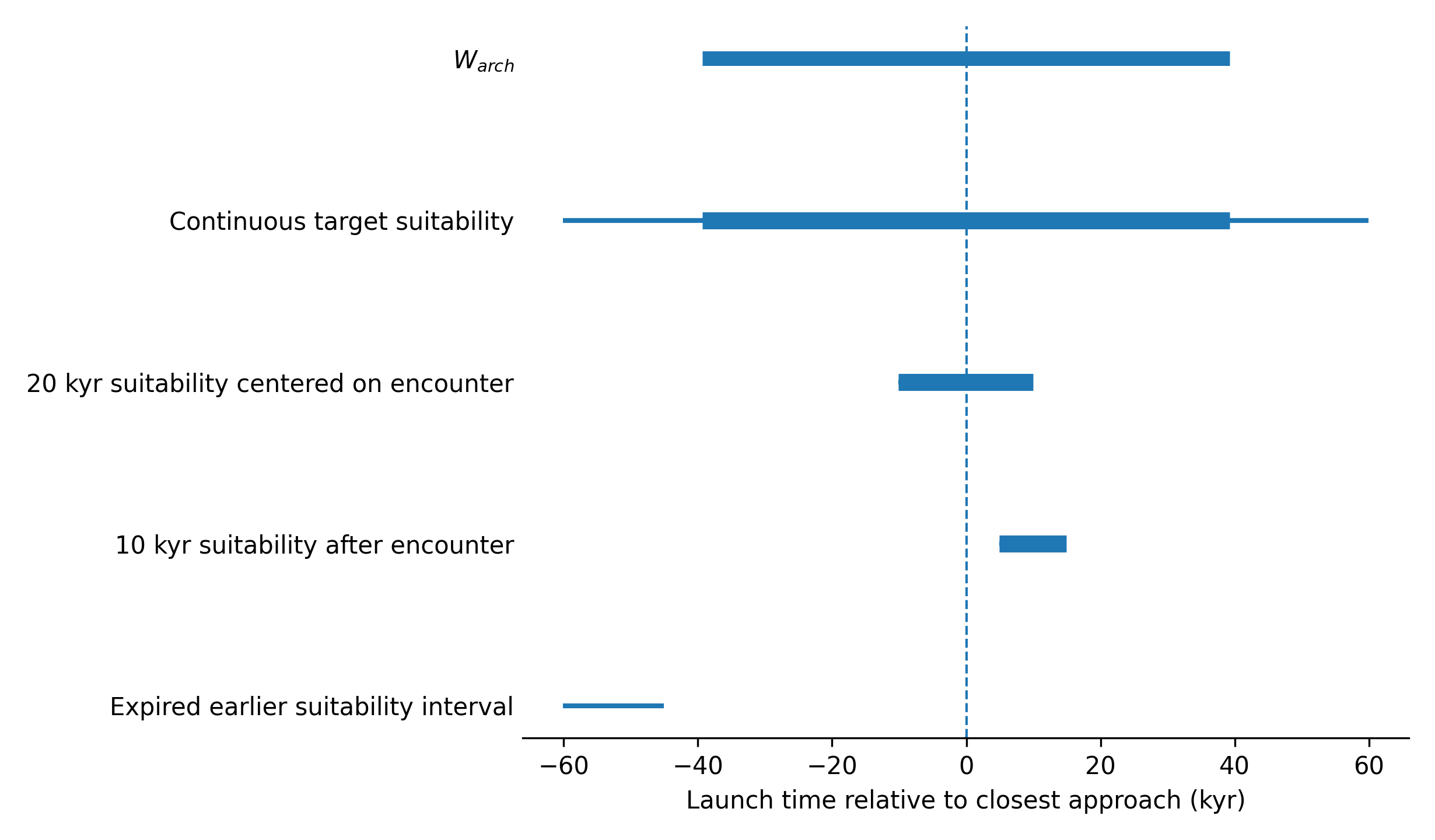
Even a non-empty W_arch only establishes that viable material could in principle reach the target system. A target world may be suitable for a particular payload only during a limited period because of changing irradiation, atmosphere, climate, liquid environments, geochemistry, impacts or other processes. Let W_env be the interval in arrival-time coordinates during which the selected target environment satisfies the payload's minimum environmental requirements. If τ_L is launch time and T(τ_L) is flight time, arrival occurs at
τ_A = τ_L + T(τ_L) . (11)
The target-environment interval must therefore be mapped back into launch-time coordinates,
W̃_env = { τ_L | τ_A(τ_L) ∈ W_env } . (12)
This mapping creates a second temporal alignment problem. A target can be generally “habitable” yet unsuitable at the actual arrival epoch; conversely, a short environmental opportunity can preserve only a small portion of a broad architecture window. Figure 4 shows purely illustrative target-suitability intervals over the approximately 78.6 kyr Longshot-like architecture window. The examples are not properties of GJ 710.
Entry and release must then be treated separately. Reaching the stellar system does not guarantee that the payload can enter a planetary, subsurface or oceanic niche without sterilization. A controlled vehicle, a lithopanspermia fragment and an impactor have different W_entry and W_release constraints. Planetary-protection practice illustrates why viable introduction and persistent establishment should not be conflated: contamination control treats delivery of viable terrestrial organisms to potentially habitable extraterrestrial environments as a serious event even though such organisms may fail to reproduce or persist (NASA 2022; Hedman et al. 2026).
6.2 A minimal establishment threshold
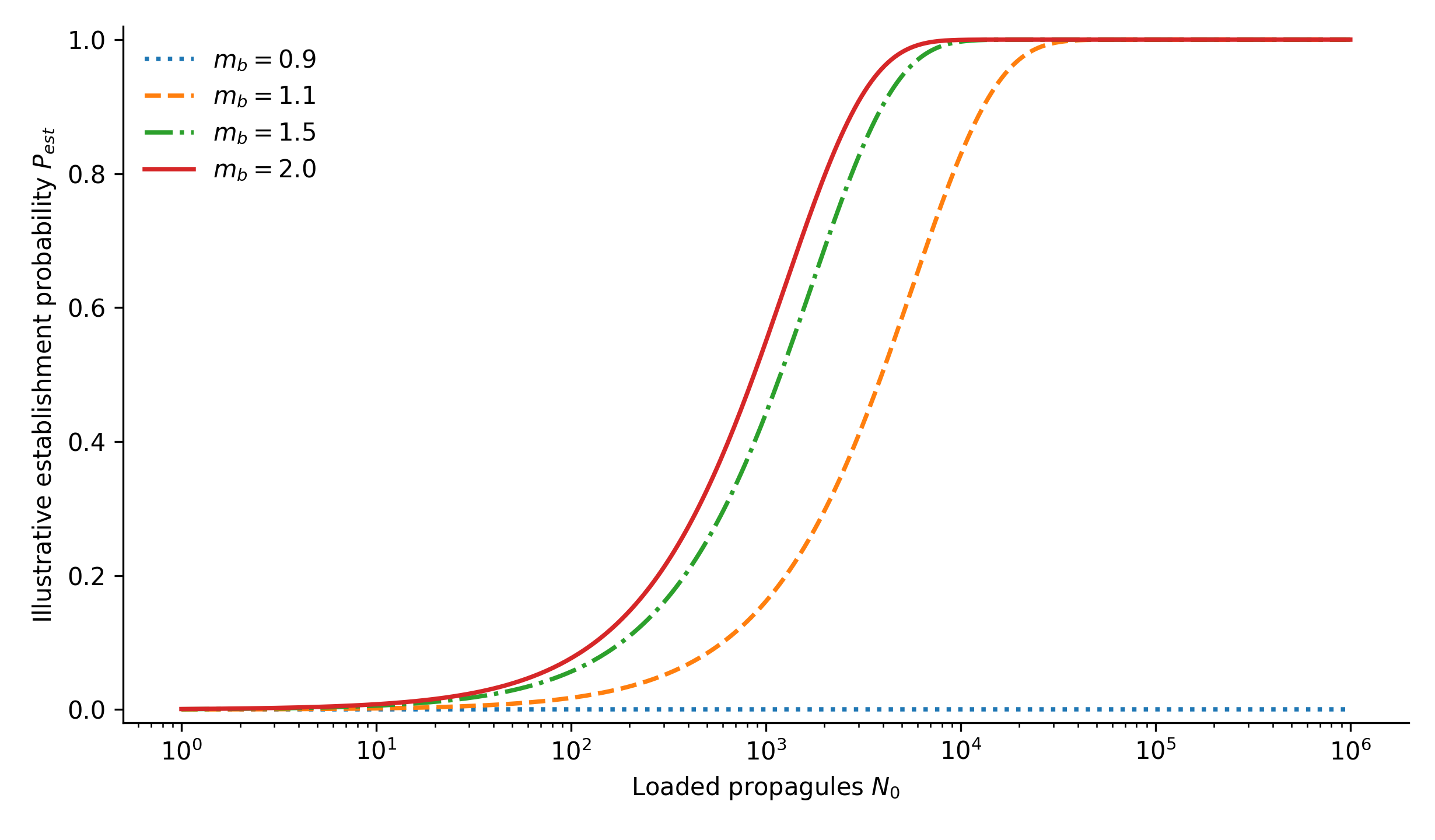
CRMM adopts a stronger success criterion than viable contamination: at least one persistent lineage must form. A minimal branching-process representation makes the establishment threshold explicit without pretending to model a real alien ecosystem. Let m_b be the mean number of reproductively successful descendants produced by each founding unit during the early establishment phase. Under a Poisson offspring model, the ultimate extinction probability q of a single established founder is the smallest solution on [0,1] of
q = exp[m_b(q−1)] . (13)
For m_b≤1, q=1; for m_b>1, q<1 (Xia 2025). The threshold should be read only as a transparent stochastic benchmark. Real populations may show density dependence, dormancy, cooperative metabolism, Allee effects, competition and environmental heterogeneity. In invasion ecology, propagule pressure nevertheless has a well-established positive association with establishment probability because larger or repeated founder populations buffer demographic and environmental stochasticity (Lockwood et al. 2005; Simberloff 2009).
Let N_0 be the number of potentially reproductive units loaded at departure and s_dep the probability that a single unit survives cruise, entry and release and reaches an appropriate microenvironment in a recoverable state. Under an independence approximation, the probability that at least one lineage avoids eventual extinction is
P_est = 1 − [1 − s_dep(1−q)]ᴺ⁰ . (14)
Equation (14) is a sensitivity model, not an extraterrestrial ecological estimate. Its main value is structural: if the local early environment is persistently subcritical (m_b≤1 in this idealized model), increasing the initial dose does not create a self-sustaining lineage. Once the system is supercritical, founder number and viable-deployment probability become important.
The final effective window can now be written
W_eff = W_arch ∩ W̃_env ∩ W_entry ∩ W_release ∩ W_est . (15)
Likewise, the single-action success term can be decomposed conceptually as p_s=p_cruise p_entry p_release P_est. The decomposition makes clear where evidence is missing. In the GJ 710 example, there is presently no defensible target planet, entry environment, m_b, s_dep or establishment dataset. The correct model output at this layer is therefore “W_eff undetermined”, not an invented migration probability.
7. Falsifiability, source traceability and bounded application to Earth
7.1 What can falsify a candidate migration history?
A candidate source–target history must survive all earlier filters. The model therefore produces several direct rejection tests. A claimed source is excluded if the relevant encounter does not overlap the target world's earliest plausible life interval; if the entire encounter remains outside any defensible W_kin; if all physically plausible rendezvous and lifetime assumptions make W_phys empty; if no specified architecture closes propulsion and braking; if the target environment is unsuitable at arrival; or if the proposed biological payload has effectively zero establishment probability under the relevant conditions.
This logic separates a general framework from a specific historical claim. Failure of an Earth-origin application would not falsify time-dependent reachability as a possible mechanism elsewhere. Conversely, demonstrating that a GJ 710-like encounter can generate a non-empty W_arch would not show that any migration event occurred.
| Layer | Evidence needed | Supportive outcome | Rejecting outcome |
|---|---|---|---|
| Astronomical dynamics | Relative trajectory and encounter uncertainty | A finite historical accessibility interval overlaps the relevant epoch | No overlap or no kinematic window under defensible capability limits |
| Mission physics | Transfer time, delta-v, energy, shielding and survival constraints | At least one physically coherent rendezvous path remains | Every admissible path exceeds a hard constraint |
| Architecture | Specified propulsion, braking/capture, payload, reliability | A closed transport architecture exists within the physical window | A required subsystem is absent or incapable |
| Target environment | Planet/moon detection and environment at arrival epoch | A suitable niche exists at the actual arrival time | No suitable target or timing overlap |
| Biological establishment | Entry survival, release survival, founder dynamics | Non-zero persistent-lineage probability | All allowed delivery/establishment routes have zero or negligible success |
Table 5. Falsifiability matrix for a specific CRMM migration claim.
7.2 Re-isolation and source-record loss are observational consequences, not evidence
A transient encounter can close after transfer. Material exchange can become prohibitively difficult, communication can cease, and physical or historical records can be destroyed or rendered inaccessible. CRMM therefore distinguishes a local evolutionary record from a pre-arrival source record. A complete local phylogeny after establishment would not, by itself, identify where the founding lineage existed immediately before arrival.
This “source-record loss” cannot be used as a shield against falsification. Absence of an identifiable source, absence of an artifact, or gaps in a geological record do not increase the probability of external origin. Indeed, high-intensity migration scenarios that should produce durable and abundant technosignatures become less plausible when such expected traces are absent. The concept only describes a possible loss of traceability after a transient connection; it is not positive evidence that a connection occurred.
7.3 Earth as a future application, not a result
Applying CRMM to the earliest terrestrial biosphere is substantially harder than the GJ 710 demonstration. Gaia-quality phase-space data can constrain stellar encounters over limited time horizons, but the specific stellar neighborhood of the Sun billions of years ago cannot be reconstructed star-by-star with comparable fidelity. Research on the Sun's birth environment and solar siblings instead provides statistical constraints on cluster density, mixing and plausible early encounter environments (Adams 2010; Martínez-Barbosa et al. 2016; Desch and Miret-Roig 2024). A defensible Earth application would therefore begin with statistical early-Solar-System environments and only later test any specific source candidate if independent evidence became available.
Accordingly, this paper does not infer that terrestrial life is exogenous. It only argues that “where did life first arise?” and “where did the earliest terrestrial lineage come from immediately before appearing on Earth?” are logically distinct questions, and that the second question can in principle be constrained by a hierarchy of dynamical, engineering and biological filters.
8. Discussion
8.1 The principal contribution is the filtering hierarchy
The strongest version of CRMM is narrower than the motivating thought experiment. Stellar motion, flyby-assisted migration and panspermia are all established topics. The proposed contribution is a common decision structure that forces those topics into the same time axis and prevents a possibility at one layer from being silently promoted into success at another. In this sense, the hierarchy W_kin→W_phys→W_arch→W_eff is more important than any single numerical value in the paper.
The GJ 710 case demonstrates why the hierarchy matters. The encounter produces large kinematic windows at sufficiently high cruise speed, but controlled rendezvous exposes a steep lifetime–delta-v trade-off. Architecture closure then distinguishes a rendezvous-capable system from a high-speed flyby. Finally, target-environment timing and establishment can eliminate a transport opportunity even after the engineering path is closed.
8.2 Limits of the present calculations
The calculations intentionally use simplified models. The local GJ 710 treatment is rectilinear and barycentric rather than a full N-body spacecraft trajectory. Planetary orbital geometry, stellar gravitational wells, finite-thrust profiles, navigation uncertainty, engine efficiency, shielding design and system reliability are omitted from the analytic rendezvous equations. The Longshot-derived delta-v envelope uses reported specific impulse and mass values in an ideal rocket-equation calculation and is not a re-simulation of the historical design. The Starshot comparison treats the baseline concept as a flyby architecture and does not exclude future system-specific braking concepts.
The biological layer is even less constrained. Tanpopo survival values are experimental extrapolations in a near-Earth exposure context, not interstellar lifetime measurements. The branching-process model assumes a stationary early reproduction parameter and independent founders, assumptions that may be violated by real microbial ecology. Target-environment timing scenarios are illustrative because no target planet is presently specified for GJ 710.
These simplifications are acceptable only because the paper does not use them to estimate a real cosmic migration probability. They are boundary calculations showing how a window can survive or disappear. Future work should replace each analytic proxy with a domain-specific model as data permit.
8.3 A research program built around progressively harder data
The most productive next step is not to search for ever more speculative source stars but to apply the hierarchy to systems with improving empirical constraints. Gaia encounter solutions can populate the dynamical layer. Exoplanet detection and characterization can determine whether a target environment exists. Mission studies can provide architecture-specific performance envelopes. Experimental astrobiology can constrain survival, entry and recovery. If a genuinely independent extraterrestrial biosphere is eventually discovered, comparative biochemistry could provide a qualitatively stronger test of common ancestry than any dynamical argument alone.
This sequencing also prevents overinterpretation. A close encounter should be treated as a candidate-generating observation, not evidence of transfer. A non-empty mission window should be treated as an opportunity, not evidence of execution. Only concordant constraints across dynamics, mission physics, target environment and biology could make a specific historical transfer hypothesis competitive with local abiogenesis or other alternatives.
9. Conclusion
CRMM reframes interstellar life transfer as a time-dependent feasibility problem rather than a static distance question. Its core methodological claim is that successful transfer requires the intersection of nested windows: kinematic interception, physical rendezvous and survival, closure by a specified mission architecture, and a target-side interval in which viable material can be delivered and establish a persistent lineage.
Using the future GJ 710 encounter as a dynamical calibration shows that real relative motion can produce finite, computable launch windows. Adding controlled velocity matching then demonstrates that lifetime can dominate the propulsion threshold: at the GJ 710 closest distance, the ideal minimum rendezvous delta-v changes from approximately 122 km s−1 for a 1000 yr transfer to approximately 15,180 km s−1 for an 8 yr transfer. Architecture and target-side filters can subsequently close the window entirely.
The framework therefore does not support the conclusion that life migration is common, inevitable, or responsible for life on Earth. Its value is the opposite: it provides a structured way to reject specific migration scenarios. Any candidate history that fails one hard layer should be discarded rather than rescued by broadening an undefined “cost” function. In that restricted sense, cosmic reachability becomes a falsifiable research framework linking stellar dynamics, mission engineering, astrobiology and population establishment.
Data and code availability
All numerical values generated for the illustrative calculations follow from the equations and parameter values reported in the manuscript. A reproducibility script and tabulated outputs are provided as Supplementary Material. Observational parameters for GJ 710 are taken from the cited published sources; no proprietary observational data are used.
Author contribution
Y.Z.: conceptualization, methodology, formal analysis, investigation, visualization, writing—original draft, and writing—review and editing.
Funding
This research received no specific grant from any funding agency, commercial or not-for-profit sectors.
Competing interests
The author declares no competing interests.
Acknowledgements and AI-use declaration
OpenAI ChatGPT (GPT-5.6 Sol; accessed via the ChatGPT web application, https://chatgpt.com/, in October 2026) was used to assist with English translation, structural editing, literature cross-checking, numerical consistency checks, and drafting Python code for the illustrative calculations and figures. The author reviewed the scientific argument, equations, numerical outputs, citations and final text, independently decided what to retain, and assumes full responsibility for the manuscript. No AI system is listed as an author.
References
Adams, F. C. 2010, The Birth Environment of the Solar System, Annual Review of Astronomy and Astrophysics, 48, 47–85. https://doi.org/10.1146/annurev-astro-081309-130830
Adams, F. C., Napier, K. J. 2022, Transfer of Rocks Between Planetary Systems: Panspermia Revisited, Astrobiology, 22, 1429–1442. https://doi.org/10.1089/ast.2021.0187
Adams, F. C., Spergel, D. N. 2005, Lithopanspermia in Star-Forming Clusters, Astrobiology, 5, 497–514. https://doi.org/10.1089/ast.2005.5.497
Adamski, P., Eleveld, M., Sood, A., et al. 2020, From self-replication to replicator systems en route to de novo life, Nature Reviews Chemistry, 4, 386–403. https://doi.org/10.1038/s41570-020-0196-x
Bailer-Jones, C. A. L. 2022, Stars That Approach within One Parsec of the Sun: New and More Accurate Encounters Identified in Gaia Data Release 3, The Astrophysical Journal Letters, 935, L9. https://doi.org/10.3847/2041-8213/ac816a
Bailer-Jones, C. A. L., Rybizki, J., Andrae, R., Fouesneau, M. 2018, New stellar encounters discovered in the second Gaia data release, Astronomy & Astrophysics, 616, A37. https://doi.org/10.1051/0004-6361/201833456
Beals, K. A., Beaulieu, M., Dembia, F. J., Kerstiens, J., Kramer, D. L., West, J. R., Zito, J. A. 1988, Project Longshot: An Unmanned Probe to Alpha Centauri, NASA Contractor Report NASA-CR-184718, NASA Technical Reports Server.
Belbruno, E., Moro-Martín, A., Malhotra, R., Savransky, D. 2012, Chaotic Exchange of Solid Material Between Planetary Systems: Implications for Lithopanspermia, Astrobiology, 12, 754–774. https://doi.org/10.1089/ast.2012.0825
Carroll-Nellenback, J., Frank, A., Wright, J. T., Scharf, C. 2019, The Fermi Paradox and the Aurora Effect: Exo-civilization Settlement, Expansion, and Steady States, The Astronomical Journal, 158, 117. https://doi.org/10.3847/1538-3881/ab31a3
Crick, F. H. C., Orgel, L. E. 1973, Directed panspermia, Icarus, 19, 341–346. https://doi.org/10.1016/0019-1035(73)90110-3
Desch, S., Miret-Roig, N. 2024, The Sun's Birth Environment: Context for Meteoritics, Space Science Reviews, 220, 76. https://doi.org/10.1007/s11214-024-01113-x
Fernandez-Puig, E., Morales, J. C., Ribas, I., Laguna-Miralles, J., Guijosa, P. 2026, Stellar encounters in the solar neighbourhood and the special case of GJ 710, Astronomy & Astrophysics, 710, A252. https://doi.org/10.1051/0004-6361/202659497
Gonzalez, G., Brownlee, D., Ward, P. 2001, The Galactic Habitable Zone: Galactic Chemical Evolution, Icarus, 152, 185–200. https://doi.org/10.1006/icar.2001.6617
Hansen, B. M. S., Zuckerman, B. 2021, Minimal Conditions for Survival of Technological Civilizations in the Face of Stellar Evolution, The Astronomical Journal, 161, 145. https://doi.org/10.3847/1538-3881/abd547
Haqq-Misra, J., Fauchez, T. J. 2022, Galactic Settlement of Low-mass Stars as a Resolution to the Fermi Paradox, The Astronomical Journal, 164, 247. https://doi.org/10.3847/1538-3881/ac9afd
Hedman, N., Coustenis, A., Doran, P., et al. 2026, The COSPAR Panel on Planetary Protection and the COSPAR Policy on Planetary Protection: an overview of governance and activities, Philosophical Transactions of the Royal Society A, 384, 20240429. https://doi.org/10.1098/rsta.2024.0429
Heller, R., Hippke, M. 2017, Deceleration of High-velocity Interstellar Photon Sails into Bound Orbits at α Centauri, The Astrophysical Journal Letters, 835, L32. https://doi.org/10.3847/2041-8213/835/2/L32
Horneck, G., Klaus, D. M., Mancinelli, R. L. 2010, Space Microbiology, Microbiology and Molecular Biology Reviews, 74, 121–156. https://doi.org/10.1128/MMBR.00016-09
Kawaguchi, Y., Shibuya, M., Kinoshita, I., et al. 2020, DNA Damage and Survival Time Course of Deinococcal Cell Pellets During 3 Years of Exposure to Outer Space, Frontiers in Microbiology, 11, 2050. https://doi.org/10.3389/fmicb.2020.02050
Lineweaver, C. H., Fenner, Y., Gibson, B. K. 2004, The Galactic Habitable Zone and the Age Distribution of Complex Life in the Milky Way, Science, 303, 59–62. https://doi.org/10.1126/science.1092322
Lingam, M., Grimaldi, C., Balbi, A. 2022, A birth-death-migration model for life in astrophysical environments, Monthly Notices of the Royal Astronomical Society, 509, 4365–4371. https://doi.org/10.1093/mnras/stab3108
Lockwood, J. L., Cassey, P., Blackburn, T. 2005, The role of propagule pressure in explaining species invasions, Trends in Ecology & Evolution, 20, 223–228. https://doi.org/10.1016/j.tree.2005.02.004
Lubin, P. 2016, A Roadmap to Interstellar Flight, Journal of the British Interplanetary Society, 69, 40–72. arXiv:1604.01356
Martínez-Barbosa, C. A., Brown, A. G. A., Boekholt, T., et al. 2016, The evolution of the Sun's birth cluster and the search for the solar siblings with Gaia, Monthly Notices of the Royal Astronomical Society, 457, 1062–1075. https://doi.org/10.1093/mnras/stw006
Mileikowsky, C., Cucinotta, F. A., Wilson, J. W., et al. 2000, Natural Transfer of Viable Microbes in Space: 1. From Mars to Earth and Earth to Mars, Icarus, 145, 391–427. https://doi.org/10.1006/icar.1999.6317
Mitrašinović, A., Vukotić, B., Micic, M., Ćirković, M. M. 2023, Dynamical aspects of Galactic habitability in N-body simulations, Publications of the Astronomical Society of Australia, 40, e054. https://doi.org/10.1017/pasa.2023.54
National Aeronautics and Space Administration (NASA). 2022, NASA-STD-8719.27: Implementing Planetary Protection Requirements for Space Flight, Baseline 30 August 2022.
Parkin, K. L. G. 2018, The Breakthrough Starshot system model, Acta Astronautica, 152, 370–384. https://doi.org/10.1016/j.actaastro.2018.08.035
Romanovskaya, I. K. 2022, Migrating extraterrestrial civilizations and interstellar colonization: implications for SETI and SETA, International Journal of Astrobiology, 21, 163–187. https://doi.org/10.1017/S1473550422000143
Simberloff, D. 2009, The Role of Propagule Pressure in Biological Invasions, Annual Review of Ecology, Evolution, and Systematics, 40, 81–102. https://doi.org/10.1146/annurev.ecolsys.110308.120304
Spitoni, E., Palla, M., Magrini, L., et al. 2025, Shaping Galactic habitability: Impact of stellar migration and gas giants, Astronomy & Astrophysics, 700, A58. https://doi.org/10.1051/0004-6361/202555050
Sutherland, J. D. 2017, Studies on the origin of life—the end of the beginning, Nature Reviews Chemistry, 1, 0012. https://doi.org/10.1038/s41570-016-0012
Valtonen, M., Nurmi, P., Zheng, J.-Q., et al. 2009, Natural Transfer of Viable Microbes in Space from Planets in the Extra-Solar Systems to a Planet in Our Solar System and Vice Versa, The Astrophysical Journal, 690, 210–215. https://doi.org/10.1088/0004-637X/690/1/210
Veras, D., Armstrong, D. J., Blake, J. A., et al. 2018, Dynamical and Biological Panspermia Constraints Within Multi-planet Exosystems, Astrobiology, 18, 1106–1122. https://doi.org/10.1089/ast.2017.1786
Xia, X. 2025, The Branching Process: A General Conceptual Framework for Addressing Current Ecological and Evolutionary Questions, Life, 15, 1910. https://doi.org/10.3390/life15121910
阅读 — · 读完 —
评论
暂时还没有评论。